式Mantic arts dossier · The Three Cosmic Boards and spatiotemporal methods
太乙
Tàiyǐ·Taiyi cosmic-board calculation
One of the Three Boards, arranging Taiyi and associated agents through accumulated years, epochs, nine palaces and configurations, traditionally for state affairs, warfare, disasters and long-term cycles.
- Aliases
- Taiyi calculation, Taiyi board method
- Formation
- Han bibliographic traces; full received systems chiefly visible after the Tang-Song
- Evidence status
01Core principles
Core principles
Translate formulas into structure: what enters, how the model is arranged, and which relations drive interpretation.
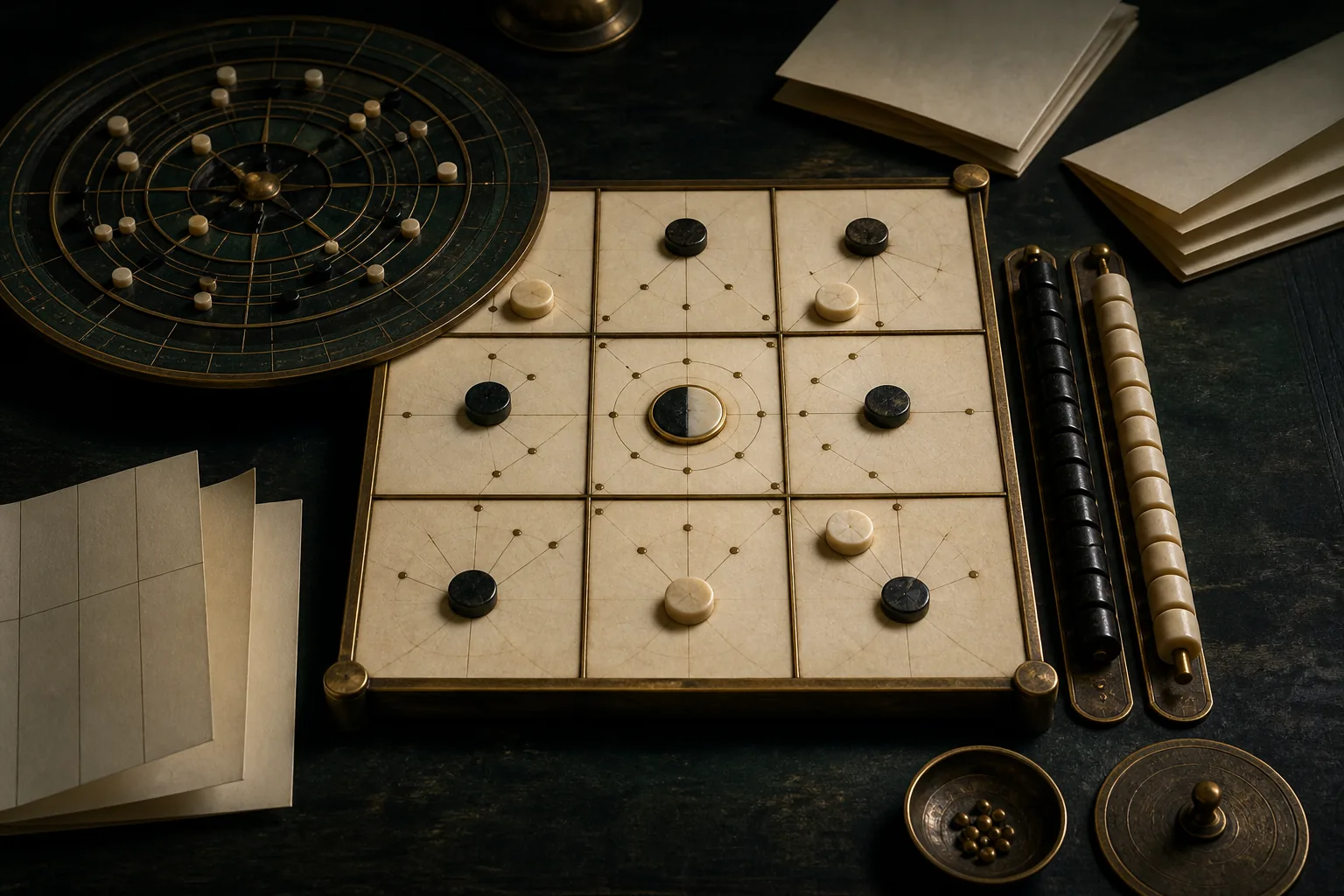
An epoch and accumulated-year calculation yields a configuration; Taiyi, Wenchang, Shiji and host-guest generals are placed in palaces and read through interior-exterior, host-guest and positional relations.
Key concepts
- epoch and accumulated years
- nine palaces
- host and guest
- cosmic agents
02Origins and historical development
Origins and historical development
Keep traditional accounts, surviving evidence and later transformations distinct.
The Han bibliography lists a Taiyi-yinyang work, but early Taiyi cult, bibliographic traces and the received algorithm cannot be assumed to form an unbroken line. Tang-Song sources grouped Taiyi with Qimen and Liuren; Ming compilations enlarged the corpus.
03Evidence limits and research debates
Evidence limits and research debates
Mystery belongs to the unknown—not to presenting uncertainty as fact.
Epochs, configuration rules and agent names differ across texts. Invention by the Yellow Emperor is a lineage claim, not a historical authorship finding.
This dossier supports historical, textual and methodological study. Internal traditional explanations are not modern empirical validation and do not replace medical, legal, financial or other professional advice.
04Core texts and materials
Core texts and materials
- 01Taiyi Jinjing Shijing
- 02Taiyi Tongzong Baojian
- 03Relevant entries in the Han bibliography