命Mantic arts dossier · Fate calculation and astral nativities
七政四余与五星星命
Qīzhèng Sìyú yǔ Wǔxīng Xīngmìng·Seven Governors, Four Auxiliaries and planetary nativities
A natal system using the Sun, Moon, five visible planets and four auxiliary points with twelve houses, lunar lodges, degrees and time-lord techniques.
- Aliases
- Guolao astrology, Five-Planet art, Qintang astrology
- Formation
- Stabilized in China during Tang-Song through indigenous and Indo-Iranian elements
- Evidence status
01Core principles
Core principles
Translate formulas into structure: what enters, how the model is arranged, and which relations drive interpretation.
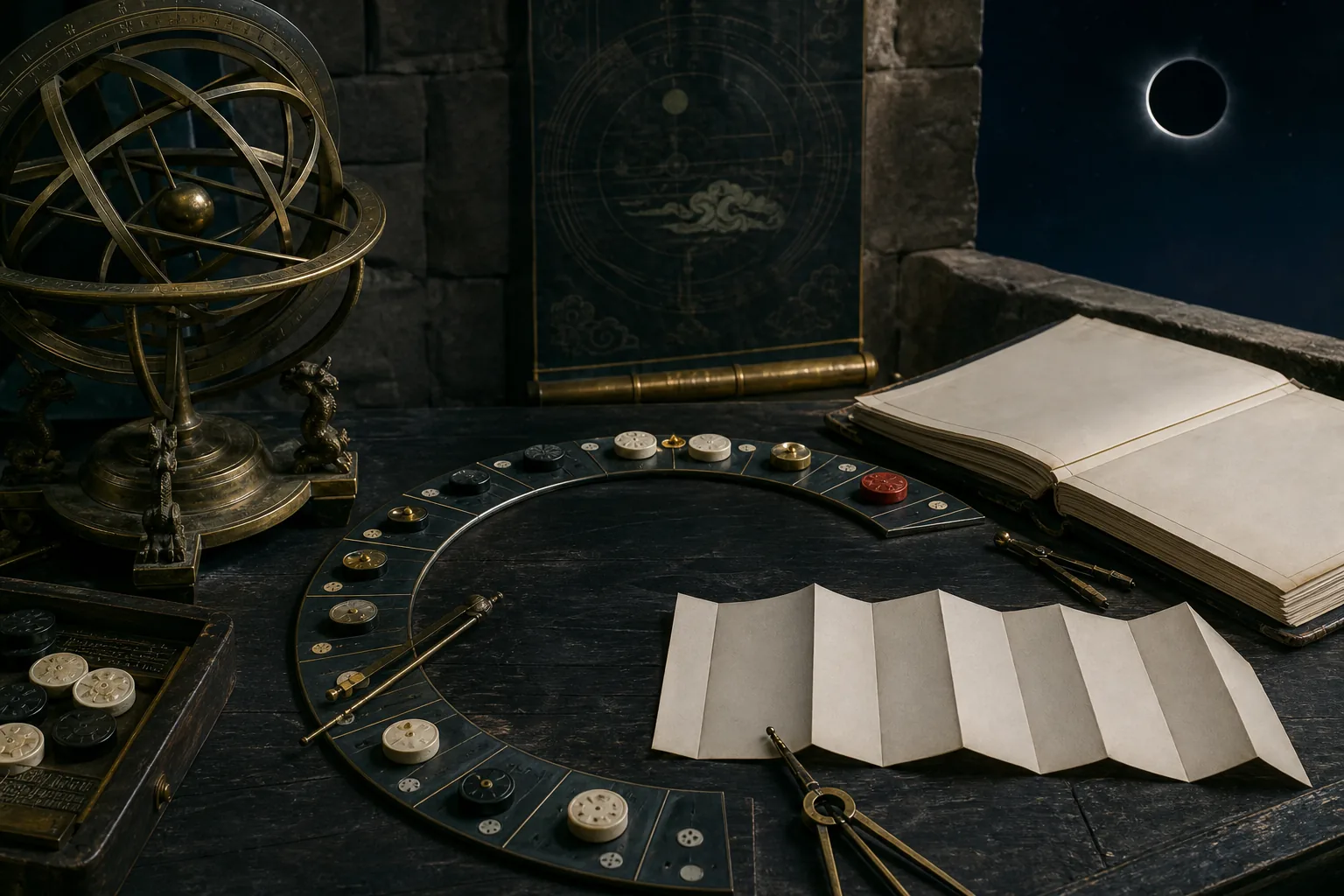
Calendrical astronomy first determines actual celestial positions; these are placed by palace and lunar lodge and read through condition, aspects, motion and time periods. Traditions differ on the four auxiliaries, house systems and time lords.
Key concepts
- seven governors
- four auxiliaries
- twelve houses
- twenty-eight lunar lodges
02Origins and historical development
Origins and historical development
Keep traditional accounts, surviving evidence and later transformations distinct.
Medieval Chinese star lore, phases and lunar lodges interacted with Indian, Iranian and Buddhist astronomical transmissions. Qintang, Guolao and other lines emerged from Tang-Song through Ming and interacted with Four-Pillar calculation.
03Evidence limits and research debates
Evidence limits and research debates
Mystery belongs to the unknown—not to presenting uncertainty as fact.
It uses real celestial positions, but natal judgments are not conclusions of modern astronomy. A direct transmission from Zhang Guo has also been questioned by bibliographers.
This dossier supports historical, textual and methodological study. Internal traditional explanations are not modern empirical validation and do not replace medical, legal, financial or other professional advice.
04Core texts and materials
Core texts and materials
- 01Guolao Xingzong
- 02Xingming Suyuan
- 03Xingxue Dacheng